The 12 Questions Every Real Estate Professional Should Ask Before Advancing a Data Center Site
A decision-level guide to land, power, interconnection, and sequencing in an infrastructure-constrained market.
Most data center conversations start too late.
They begin after a site is emotionally chosen or capital expectations have already hardened. By then, the most important risks are no longer visible, let alone fixable.
This guide exists to intervene earlier.
No spam. No sales emails. Just the PDF and a short follow up series expanding on the ideas.
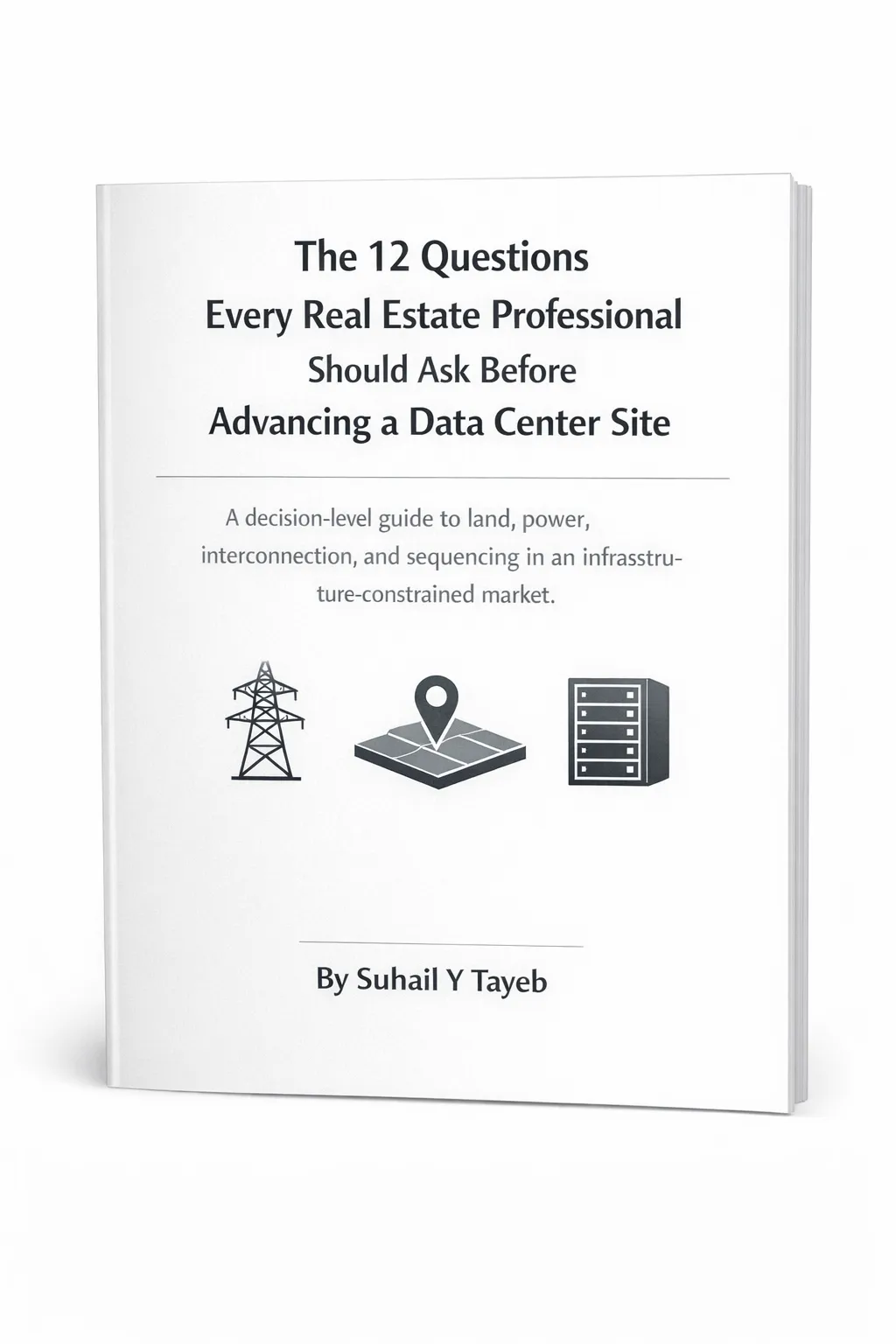
Data centers are not primarily a technology story. They are a land and infrastructure problem governed by power availability, interconnection timelines, transmission access, cooling constraints, jurisdictional sequencing, and local politics. These constraints move slowly and unevenly. They do not respond to spreadsheets, capital urgency, or market narratives.
If you are evaluating land, capital, or partnerships tied to data center development, this guide is designed to help you pause at the right moment and ask better questions before decisions become irreversible.
What This Guide Is (and Is Not)
This is not a market forecast. It is not a technical manual. It is not a pitch deck or an investment thesis.
It is a practical reframing tool for real estate and investment professionals who already understand development risk, but are encountering data centers as a category that does not behave like traditional real estate.
The goal is not to push you toward a deal. The goal is to help you recognize when not to advance one.
Why “Digital Dirt” Matters
Not all land is equal in a data center economy.
Some parcels sit at the intersection of power, fiber, transmission access, jurisdictional alignment, and political tolerance. Most do not. The mistake many capable professionals make is assuming site selection is an early, reversible step. In data centers, that assumption fails quickly.
Land decisions made casually or prematurely lock in risks that cannot be priced later. Once you commit to a grid position, a cooling profile, or an approval pathway, optionality collapses. This guide is built to surface those realities before momentum takes over.
What You’ll Learn Inside
You will learn how to think about data center sites at the right altitude, before technical detail or capital pressure obscures judgment.
The guide walks through:
- Why data centers break traditional real estate logic and valuation instincts
- How power, fiber, and cooling function as a constraint stack, not independent variables
- Why interconnection is a timeline risk, not a line item
- How transmission corridors and substations create leverage that acreage does not
- Why brownfields and industrial land are often harder, not easier, to reuse
- How jurisdictional edge cases, including tribal adjacency, quietly reshape timelines
- Why water, cooling, and environmental limits increasingly determine durability
The 12-Question Readiness Checklist
At the center of the guide is a 12-question readiness checklist designed to be used early, before sites are advanced, narratives are built, or capital is committed.
The checklist is intentionally non-technical.
It is designed to force clarity on power, timing, jurisdiction, sequencing, and exit assumptions in plain language. These are questions any serious real estate or investment professional should be able to ask before advancing a site, even if they are not an engineer or operator.
If answering these questions feels uncomfortable, that is the point. Most sites should fail this screen. Walking away early is not hesitation. It is discipline.
Who This Is For
This guide is written for:
- Real estate developers evaluating data center land or partnerships
- Investors assessing exposure to digital infrastructure
- Professionals moving from industrial or logistics into data centers
- Capital allocators who want to understand where risk actually sits
- Anyone who senses that current data center narratives are skipping steps
If you are looking for hype, speed, or deal promotion, this is not that.
If you want orientation before commitment, this guide was written for you.
Get the Guide
Enter your email below and you will receive an immediate download of the full PDF.
No urgency. No pressure. Just a tool you can use at your own pace.
No spam. No sales emails. Just the PDF and a short follow up series expanding on the ideas.
The frameworks outlined in this guide were developed and refined through live work with investors, developers, and operators navigating real projects in real time.
If this reframes how you think about data center sites, you will hear from me over the next few days with additional context and ways some readers choose to go deeper. If not, the guide stands on its own.
Suhail Y Tayeb
© 2026 Suhail Y Tayeb. All rights reserved.